Good lord I’m not saying “you personally have to be violently harmed by cishets to be queer” I’m saying that the term is exclusively reserved for the communities who’ve historically experienced oppression centered around that slur and experienced the violence that it embodies (ie LGBT people)
You’re spouting some nonsense interpretation where you could say “some lesbians are queer but not all” when what I’m literally saying is “lesbians can call themselves queer because the lesbian community has been a target of this slur and experienced horrific violence as part of it”. Ace/aro people who lack same-gender attraction have no place trying to reclaim it because it was never aimed at their community.
Except that historically, people have absolutely been targeted as queer for asexual behavior.
Everybody feel free to grab a beverage and get comfortable, because I spent a lot of time on Google today. (Asexuals, listen up, because we actually have some situations where you are represented in history here.)
Historically, people got labelled queer, and/or queer-bashed, for two major things.
The first was deviating from strict gender norms.
The second was not having hetero sex.
There are tons of examples of white people literature from the 1800s and early 1900s that use terms like “confirmed bachelor” and “spinster aunt” to imply that somebody was queer.
(I was going to say something like European/American/Canadian literature, but let’s call a spade a spade.)
Sure, nowadays we look back at that and go, “everybody knew those people were gay, it was just code for gay, nobody thought anybody was asexual, that wasn’t a thing back then.”
Of course, that still means that people who we would now call asexual would have been getting queer-bashed because people thought they were gay. So all those asexual people, already, have earned their queer stripes under the rubric above – that they are part of a community that got violently oppressed for being perceived as queer.
But is that all that was happening? Were straight people actually cool with people who they thought just weren’t having any sex at all?
Let’s see! (This is code for “hell no.”)
My favorite example that I came across was the Spinster Movement.
The Spinster Movement was really long-lived, from around the 1880s through the 1930s. It was a group of women who either felt no sexual attraction, or felt some sexual attraction but didn’t want to have sex. (I will be the first to say that I’m sure that there were also members who nowadays would identify as lesbian, bi, and trans. But it wasn’t the focus.)
The movement particularly focused on opposing sex work, sex trafficking, and child sexual abuse. It was deeply tied up in the suffrage movement, which fought for the vote specifically so that women could oppose these things in the political arena. (There’s a lot more about this in a book called The Spinster and Her Enemies, by Sheila Jeffreys.)
“[in Norway], in
the 1920s and 1930s, female sexuality was suddenly discovered and all
women were supposed to have and enjoy their sexuality. At this point,
frigidity and asexuality also became a topic, a very problematic topic.
“You could say that the spinsters became queer because they didn’t have
sex or didn’t take part in sexual activities, and also because they
started to be perceived as potentially homosexual.
“Thus, the romantic
spinster friendships of the earlier phase that were not seen as
problematic in a sexual way became highly problematic in the 1920s and
1930s. Suddenly, all female relationships were seen as suspicious, they
were seen in a new sexual light.“
Notice the “and also” – they were queer for not having sex, AND they were queer for starting to be perceived as possibly lesbians.
In fact, “spinsters” were routinely slammed this way. In Britain, for example, the teachers’ union was attacked over and over with the double spectre of asexuality and lesbianism.
One example from Women’s History: “…The fear of spinsters and lesbians affected women teachers in Britain between the wars. A 1935 report in a newspaper of an educational conference expressed the threat in extreme terms: ‘The women who have the responsibility of teaching these girls are many of them themselves embittered, sexless or homosexual hoydens who try to mould the girls into their own pattern.’” It was very explicit.
And the whole thing is a common accusation that queer people still face today. That what we are is bad because it is going to destroy children and society.
People at the time felt very strongly about how unnatural it was for people not to have sex. Women, in particular, were often divided into “natural” and “unnatural” – i.e. queer – spinsters. Natural ones were widows; unnatural ones were those we have seen here.
In her book “Family Ties in Victorian England,” Claudia Nelson quotes writer Eliza Linton’s description of “unnatural and alien” spinsters: “Painted and wrinkled, padded and bedizened, with her coarse thoughts, bold words, and leering eyes, [the wrong kind of spinster] has in herself all the disgust which lies around a Bacchante and a Hecate in one…. Such an old maid as this stands as a warning to men and women alike of what and whom to avoid.”
Earlier, during the Victorian era, there was a popular but unsuccessful movement, for decades, pushing to evict spinsters over 30 from Britain, and send them to Canada, Australia, or the United States instead. They were perceived, at best, as “surplus females”, in part because there were many more women than men in the population there at that time.
There was some overlap between the different kinds of queer. Straight people, as a group, had even less understanding and interest then than they do now of what the different flavors of queer might be.
Shannon Jackson’s essay, “Toward a Queer Social Welfare Studies,” gives a good example of how describes how critics of Jane Addams’ Hull-House “called the settlement ‘unnatural,’ worrying that its women were ‘spinsters’ or that its men were ‘mollycoddles’.” In that case, I would guess that they meant “women who have sex with women”.
It’s a good example of how much they conflated the different kinds of queer – that some straight people could use the term to slam people for being asexual, and others could use it to slam people for the opposite. And it’s also a good example of how little they cared which of us they were attacking. The important thing, to them, was that we weren’t having solely hetero sex and living our lives centered around being hetero. Everything else was just details.
(Also FWIW, I want to note that I meant no disrespect to any of the previous commenters or the OP in cutting the previous posts from queerdemonslesbiandoe @punkrcgers and sushi-moss. Tumblr wouldn’t let me post my long-ass reply without trimming; it mysteriously “lost” the whole thing like it always does when I reply at length to a long thread, and I had to rewrite it.)
Also, this is a lot about women, but an unmarried man over a certain age was also considered “a threat to society” (and as mentioned above the term “confirmed bachelor” is still code for gay)
Right? I didn’t know ANYTHING about the Spinster Movement before I read about it yesterday, I didn’t even know that it existed. So I suspect that there are a shit-ton more examples like this. It could fill a really interesting book.
also, u know, so-called corrective rape is a thing that is done to people for not being cishet, including ace people. so like. “ace ppl never experience the kind of abuse “real” queer ppl do” just doesnt work. ok?
This is really interesting and I’d be very interested in finding out more about how aromantic allosexual people fit into this too. Did they just have casual sex (regardless of the perceived immorality of that), have romantic and sexual marriages, or just abstain from those relationships altogether?
Your honor! Please direct your attention towards the manga.
As you can see there are small pieces of paper sticking out of every volume.
But no such paper is sticking out of the Batman comic.
The reason? The Batman book doesn’t belong to the library. The photographer put it there to take a picture.
Once again making hasty assumptions, Wright?
First of all, I’d like to direct the court’s attention to this particular spot, in the top right-hand corner.
Notice how the words are blocking the top of the Batman book.
With this in mind, how can you claim that there is “no such paper sticking out of the Batman comic”?!
Say whaaaat?
Well uhm
Look at the size of the paper pieces, they’re all sticking pretty far out.
If there was paper in the batman comic, it would be big enough to stick up over the text.
And while gravity does exist, it probably won’t make the paper do a 90 degree turn and just lean horisontally left at the middle.
Still grasping for straws, Wright?
Hypothetically, if there were a paper there, this picture would not be able to prove its presence. I’ve taken the liberty of drawing a diagram to illustrate my point. We are faced with three possibilities. It is possible that (1) the paper was simply tucked in deeper than the others.
Paper is a soft material, Wright. It’s not unreasonable for it to do a (2) 90 degree turn.
Or perhaps, (3) a paper does not exist there at all.
Either way, you cannot prove your client innocent without sufficient evidence.
Which, of course, is impossible thanks to the obtrusive words.
I’m sorry Edgeworth.
I concede that I can’t disprove theory 1
But the image you submited for theory 2 is contradictory.
Look at the tilt of the other papers. They clearly prove how much the paper would tilt.
And theory 3 is my point! Why would the library’s book not have this piece of paper when the other library books do?
While you still have thory 1, there is another contradiction.
The books are not in alphabetical order, this proves that the batman comic was placed there specifically for the picture!
Ack.
(Perhaps I should’ve left the artistry to the forensic artist…)
Now hold it right there! It doesn’t matter which direction the paper is going because it’s impossible to prove it even exists!
Those theories are all the same! We do not have enough information to prove them. There could be an infinite amount of papers in there for all we know. I simply presented them only so that the court could better understand your baseless conjecture!
… I suppose the order of the books do seem out of the ordinary. However, therein lies not just one possibility. Clearly, those are Japanese graphic novels, also known as “manga”. And the Batman comic book is a graphic novel, too, no?
Seeing as it currently has only graphic novels in the shelf, it is possible that any other novels have simply not yet been restocked. Asserting whether or not this effect was deliberate is useless– there is no way of knowing if the photographer and the captioner are the same person, let alone their involvement in this picture.
Face it Wright, you can’t prove any of these groundless accusations!
Did everyone just ignore the library sticker?
I’ve seen this before but Phoenix and Edgeworth fighting makes everything infinitely better. ❤
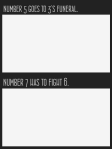
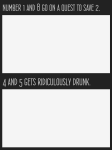
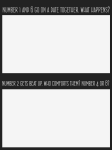
remember these, kids? they used to be so popular on deviantART way back in like 2008 and i remember i used to be so pumped about doing one, though i never really did. so, last night i even had a dream about doing one of these, so i put together some scenarios and here we are, haha! feel free to reblog or save the template for yourself if it catches your fancy!
Well since I’ve been speaking of reoccurring dreams lately I guess I should’ve expected it to happen.
At least, I’m pretty sure this is a dream I’ve had before, as I remember thinking in the dream “oh, it’s this dream” but now that I think about it I don’t remember ever having it before, might’ve been one I didn’t remember when I woke up and then I remember this one but idk it was weird.
I started at the dream as me and I was in this huge indoor stadium and I was sitting really up high with my extended family and there was like this competition for everyone in the audience to make a cake and I was going down through the stadium to try out everyone’s cake but the further down I got the more shit got real and like I was uncovering this conspiracy thing of people that wanted to hurt me/my family/take over the world or something like that it was unclear and then I got to like the bottom and I was making my own cake with like the announcer guy and he was really cute so I was like flirting with him but then suddenly I’m Ann Hathaway and he starts freaking out and yelling about how to get batter with eggs you have to fuck a frog then shit it out or something like that and then things started getting fucked up and I guess I knew from before how to “get out of the loop” (I’m assuming if I didn’t do this things would get more fucked up) and I had to stick me head in my doll house and find a mirror that you could see a sail boat in the background and I knew if I did that it would transport me to the boat and I’d be free. But the doll house made me too claustrophobic and I woke up before I could find the boat.
I’m sure we’ve covered this already – Shirts from the Men’s section are generally superior in terms of opacity, durability and warmth. For some reason, designers like to make shirts in the women’s section see-through and flimsy.
But! I’m not here to discuss their secret plot to make people buy extra shirts.
I’m here to solve the damn problem.
Kinda.
So! Lets say you were walking down the local department store, and saw this really awesome t-shirt. Hell yeah! SHIELD! In a fit of excitement, you got it for your sibling.
Unfortunately, they only had the XL size, and it looks like a potato sack on her.
Fuck.
It’s okay, we can fix this.
First, pin it to fit her. Not super tight! You don’t want any part of the shirt stretching.
We did NOT turn the shirt inside-out for that step.
After carefully taking off the shirt (neeeedles), we flattened it, keeping the pins close to the same location.
We did migrate the pins about a half-inch TOWARD the existing hemline. This is because when pinning it on a body, some cloth will be pulled more from the back, and some from the front of the shirt. If you don’t flatten it out, you’ll get weird twisted chunks later.
Then, we sewed along the curves that the pins outlined, using a super-basic straight stitch.
(At this point I had leave the house, so she just continued on her own. *shrug* Hooray for selfies and experience)
She tried on the sewed version, to make sure it was still loosely fitted. It shouldn’t be tight at all at this point.
After making sure it still fit properly (If it didn’t then you’d have to pick the stitches in problem areas and re-sew) she cut off the fabric flaps, leaving about a half-inch of of room for the stitches.
Apparently she also brought in the sleeves by about an inch. Just follow the existing bottom hemline for that part.
After that, turn your shirt inside-out.
And along the edges, where we sewed before, she used an overlock stitch.
Do that along both sides, flip your shirt inside-out, and BAM
Super awesome fitted shirt, nice seams, 100% opacity, higher durability, and some goddamn sleeves.
This shit works to shrink massive tshirts down to any body size or shape.
If you’re normally a ‘large’ and you want a fitted shirt? Just buy an XL or XXL and slim that shit down to fit your beautiful body.
This ain’t just for people with boobs, either. If you’ve got a flat chest and want your shirt to hug that killer abdomen of yours, this technique works for that too.
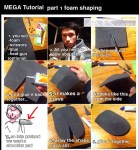
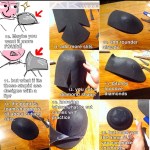
Compilation of the massive fucking N.E.R.D. squad. I’m not sure why Tumblr isn’t letting me change how the pictures are shown, someone tell me what I’m doing wrong.













 gamerfreakathon